The Complete Sonatas -
Concerto 1 : "The terrible child"
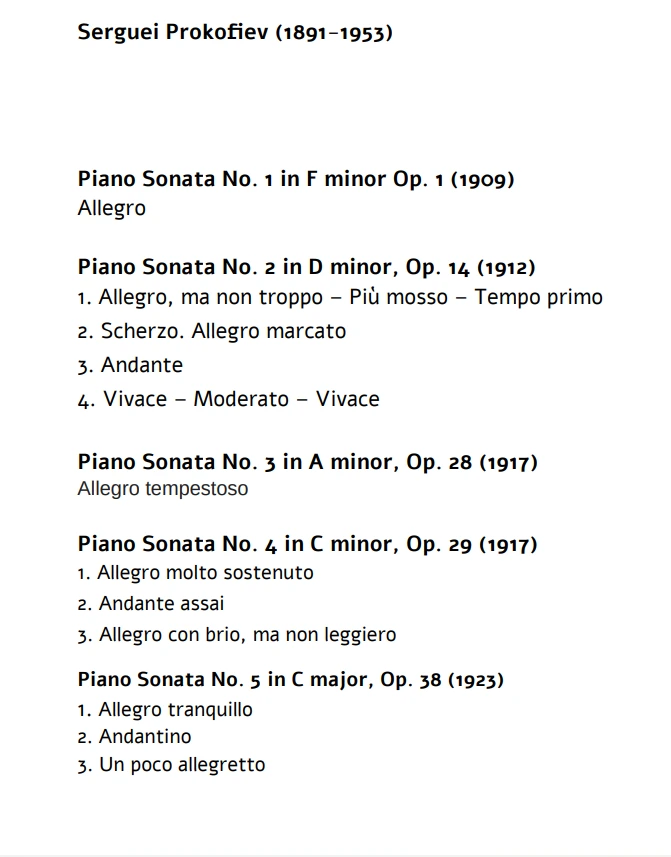
The 10 Piano Sonatas by Prokofiev represent a singularity of the 20th century, but also a sort of culmination of the piano sonata genre, formalised in the classical era (1750-1800) among others by Haydn and Mozart, and revisited by Beethoven, Brahms and many romantic composers.
In the 20th century, however, the sonata genre was neglected: too academic, too restrictive, too tied to tonality, from which there was a desire to break free. Prokofiev sought to constantly push the boundaries of this genre throughout his life (the first sonata is Op. 1 and the tenth is unfinished). This choice may stem from his taste for clear structures, in which he can fully express his propensity for strong contrasts, rhythmic transformations and the juxtaposition of very different elements.
In the 20th century, however, the sonata genre was neglected: too academic, too restrictive, too tied to tonality, from which there was a desire to break free. Prokofiev sought to constantly push the boundaries of this genre throughout his life (the first sonata is Op. 1 and the tenth is unfinished). This choice may stem from his taste for clear structures, in which he can fully express his propensity for strong contrasts, rhythmic transformations and the juxtaposition of very different elements.
-
While this first concert explores his early sonatas, we are not talking here about a composer searching for his own style. From the second sonata onwards, most of the elements that make Prokofiev's music recognisable are present: impetuous toccatas, outstanding melodic quality, a theatrical approach to virtuosity and gesturality, meticulously crafted harmony, and an almost unsettling adherence to a rigid structure.
This Concerto is certainly the most eclectic of the three. In the first sonata, Schumann's influence is omnipresent; the second is very structured and serious, dedicated along with his second Piano Concerto to his friend Maximilian Schmidthof, who committed suicide in 1913; the third is a powerful and condensed rhythmic work; the fourth is the antithesis of the third, dark, calm, and meditative; as for the fifth, written during his travels in Europe, it possesses many characteristics of French music from the 1920s, including elegance, a quest for recording, and the influence of jazz.
Emile Chandellier